


Study Regulations
Department of Physics
GeneralThe study program of the Department of Physics has a duration of four years (8 semesters) and leads to the award of a Degree in Physics. The Undergraduate Study Program of the Department includes 26 core courses, which cover the fundamental knowledge of the field, as well as approximately 48 elective courses covering a wide range of specialized subjects. In order to obtain the degree, a student must successfully attend 26 of the core courses and a number of elective courses (approximately 13) so as to complete the required number of credit units (240 ECTS). Elective courses include the Diploma Thesis as well as the Internship. All courses are semester-long, with the exception of the Diploma Thesis (annual) and the Internship (3–6 months).
Attendance The academic year begins on September 1 and ends on August 31 of the following year. The educational work of each academic year is structured into two semesters (winter and spring). Each semester includes at least 13 full weeks of teaching and 2–3 weeks of examinations. Each student is obliged to participate during the course of their studies in the educational process, as defined by law and by the decisions of the governing bodies of the University and the Department.
Students who are demonstrably employed for at least 20 hours per week may enroll as “part-time students”, following an application approved by the School Dean’s Office.
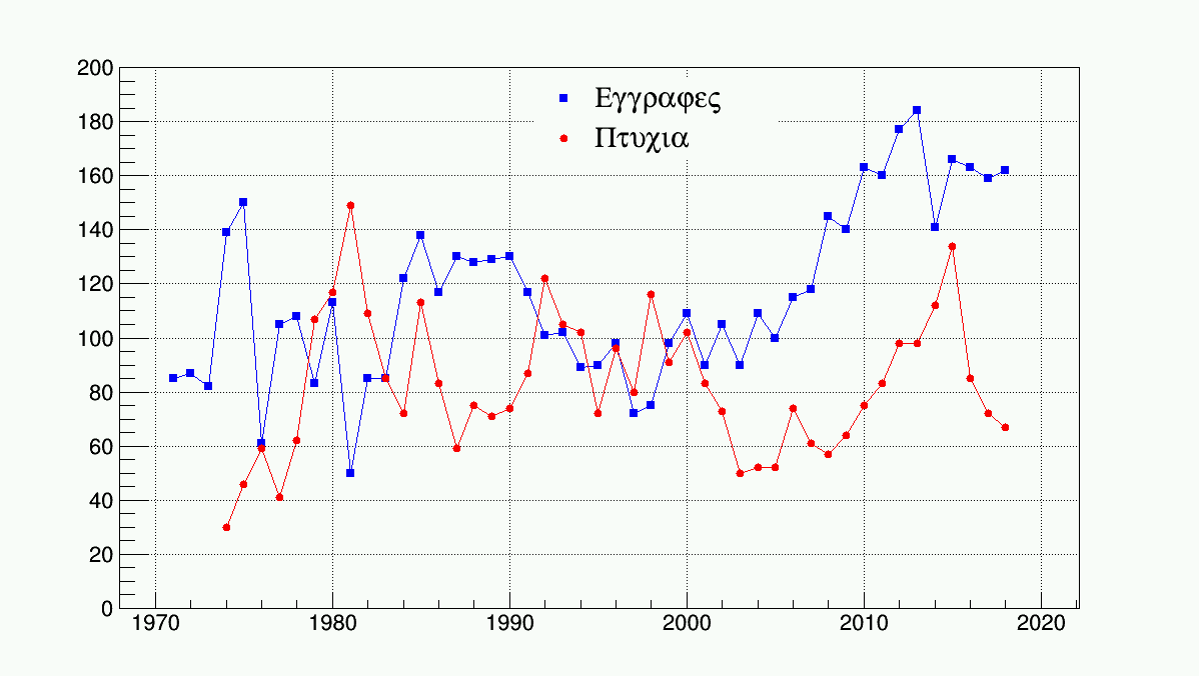
Enrolled Students/Graduates per Academic Year
Enrollment – Course Declarations Student status is acquired upon enrollment in the Department and, except in special cases of suspension/interruption of studies or disciplinary penalties, lasts until the award of the degree. Initial enrollment takes place within a specified period (usually 15 days) after the announcement of the General Examination results. Enrollment is renewed annually through the declaration of courses. Course declaration is mandatory and is carried out electronically within a specified time period at the beginning of the winter and spring semesters. The maximum number of courses a student may declare and be examined in each semester is eight (8). Priority is given to the compulsory courses of the corresponding semester (winter or spring) that the student owes from previous years. If a student fails an elective course, they may, in a subsequent semester when the course is offered, either repeat it or replace it with another elective course from those offered.
Students who have not submitted a course declaration cannot receive textbooks, are not admitted to examinations, and if for any reason they participate in examinations, their performance is not graded; even if graded, the grade obtained is not taken into account and is not recorded in any examination period.
Interruption of Studies Students who have not exceeded the maximum duration of studies may, following an application to the Department Secretariat, interrupt their studies for a period not exceeding two (2) years. The right to interrupt studies may be exercised once or in parts for a minimum period of one (1) academic semester, provided that the total duration of interruption does not exceed two (2) years if granted in parts. Student status is suspended during the interruption period, and participation in any educational process is not permitted.
Department of Physics
Examinations are conducted at the end of each semester and are attended by students who have declared and attended the corresponding courses taught. In September, before the start of the winter semester courses, resit examinations are conducted for courses of both semesters (winter and spring). The student’s grade in each course is determined by the instructor, who may at their discretion organize written and/or oral examinations and/or base the grade on the student’s performance in theoretical or laboratory exercises during the semester.
The examination schedule of each semester is determined by decisions of the Department, and its start date is announced at least one month prior to the beginning of the examination period.
For courses divided into two groups (even–odd), and when common examinations are not предусмотрed, the student is examined exclusively in the group corresponding to their registration number. In these courses, instructors are mandatorily rotated annually between the two groups.
If a student fails a course more than three times, by decision of the Dean, the student is examined—following an application—by a three-member committee of faculty members of the School with the same or related scientific field, appointed by the Dean. The instructor responsible for the examination is excluded from the committee.
From the academic year 2016–17 onwards, optional midterm quizzes have been included in the schedule of each semester, during periods when no classes are held. For the examination periods of the current academic year, please consult the Academic Calendar.
During examinations, copying, conversation, or any form of collaboration among students is prohibited, as is the possession of any unauthorized material (such as notes, textbooks, or solved exercises). Any form of fraud in the examination process is strictly prohibited, including the transmission or receipt of exam topics and solutions, as well as communication between the examinee and any persons other than examiners and invigilators by any means. The use of mobile phones or portable electronic devices (such as iPads, tablets, laptops) for any purpose is strictly prohibited (including use as a calculator or watch). Mobile phones must be completely switched off throughout the examination and during the student’s presence in the examination room, including any temporary exit. Technical means may be used to monitor compliance. In each examination room, a list is kept by the invigilators of students who exited the room (without having finally submitted their paper), recording their full name, registration number, and time of exit and return. This list is handed to the examiner at the end of the examination. The instructor of each course has the right to summon a student to an oral examination if there are, in their judgment, suspicions of copying or fraud. Students who do not respect the examination rules may, in addition to the immediate annulment of their exam paper, be subject to sanctions including suspension of student status for one or more semesters.
A necessary prerequisite for participation in the examination of a course and for the recording of the grade is the declaration of the course. Declarations are made electronically through the classweb system during a specific period at the beginning of the semester, announced on the Department’s website. Grades for examinations of a course that has not been declared according to the above procedure are not recognized and are not recorded in any examination period.
Courtyard of the Department of Physics
Maximum Number of Courses – Degree Grade In order to obtain the degree, a student must study in the Department for at least eight (8) semesters, during which they must successfully complete a series of courses amounting to at least 240 ECTS credits. For students who have successfully completed more courses, the elective courses with the greatest contribution (ratio of grade to credit units) are taken into account in the degree grade. From the remaining elective courses not included in the degree grade, up to two may, upon the student’s application, be listed on the detailed transcript and the Diploma Supplement.
The degree grade is calculated as a fraction, with the numerator being the sum of the products of the grade obtained in each course multiplied by the corresponding credit units, and the denominator being the total number of credit units required for the degree. For students who have successfully completed courses corresponding to more than 240 credit units, the elective courses with the greatest contribution (ratio of grade to credit units) participate in the degree grade up to 240 credits or the nearest higher integer, which replaces the denominator of the above fraction. If the student has completed an internship, the ECTS credits corresponding to it are subtracted from the denominator, as there is no corresponding grade. The degree grade is calculated to two decimal places.
Foreign Language The student chooses one of the foreign languages offered by the Department (English/French/German). Students who possess knowledge at level C2 of ASEP (e.g., an English Proficiency certificate) may, if they wish, be exempted from the examination of the course with a grade of seven (7). Students must include the course in their course declaration and subsequently submit an application to the Secretariat attaching a certified copy of the relevant diploma. Students who wish to improve the above grade may sit the examination in the examination periods of the academic year in which the course has been included in their declaration.
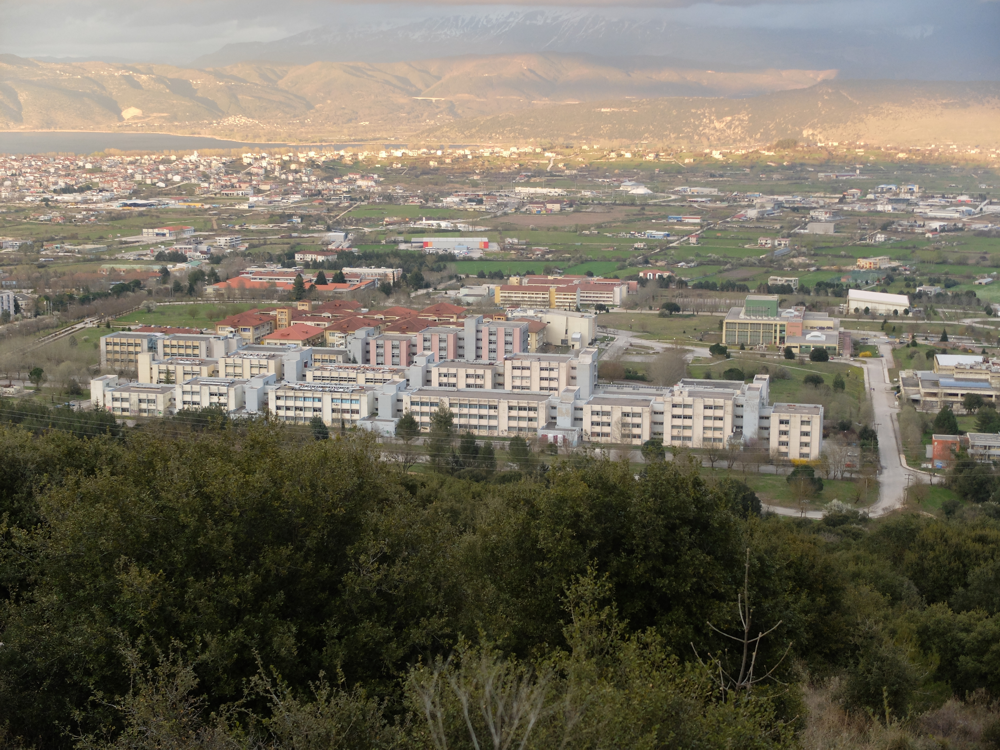
View of the Department of Physics buildings
Diploma Thesis Students who are at least in their 7th semester of studies and who have successfully completed, by the last examination period prior to declaring the course, courses corresponding to at least 120 ECTS credits may choose the course “Diploma Thesis,” which is annual and corresponds to 10 ECTS credits.
Internship From the 6th semester onwards, a student may be employed for a specific period in Greek or international organizations and companies of the public and private sector (e.g., PPC, OTE, enterprises), with the aim of practical training and specialization in subjects related to Physics. For this purpose, the student selects a faculty member as supervisor and submits to the Department Secretariat, jointly with the supervisor, a detailed description of the training and employment program, indicating the host organization and the time period. After completion of the internship, a report of activities is submitted by the student in collaboration with the supervisor, accompanied by a relevant certificate from the host organization. The report is evaluated by the Department’s Curriculum Committee. In the case of a positive evaluation, the student is awarded 3 ECTS credits for the internship. These credits count toward the 240 required for the degree but without a corresponding grade.
Transitional Provisions
- The maximum number of courses declared (eight) applies to all students regardless of the academic year of admission to the Department of Physics.
- The calculation of the degree grade using the ECTS credit system applies to students enrolled from the academic year 2010–11 onwards. For students of previous academic years, the calculation method described in the corresponding Study Guide applies.
- The present allocation of ECTS credits per course, as well as the requirement for 20 ECTS credits from the elective courses of the General Tracks of Table B, applies to students enrolled from the academic year 2010–11 onwards.